Tammie Rogers
Inspired by Dogs & Nature
Should You Take Your Dog to the Dog Park?
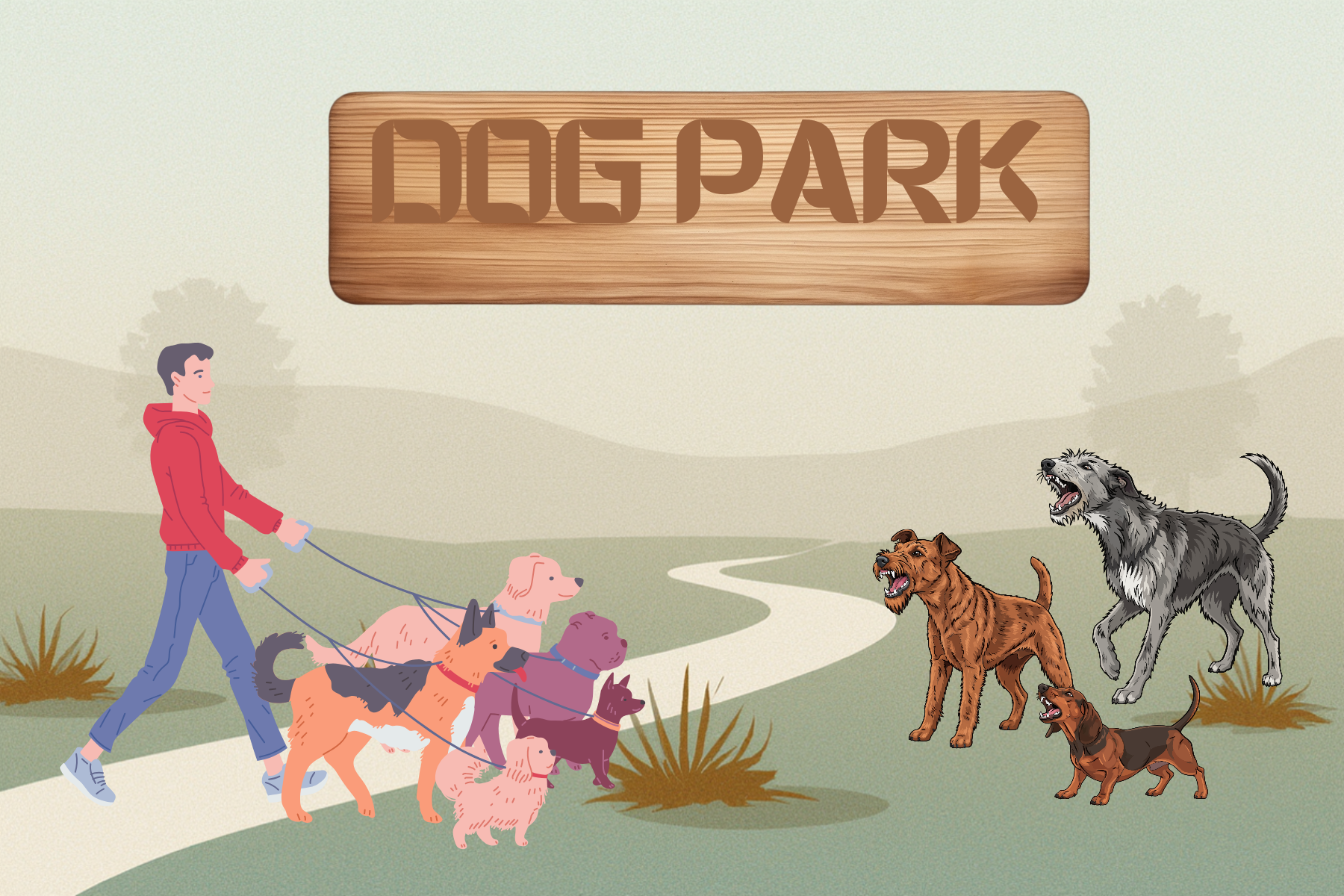
I’m opposed to taking a well-mannered, properly socialized dog to a dog park. To me, it’s akin to taking a kind and courteous child to a park full of naughty little, hoodlum bullies, whose parents are either not paying attention to their children’s ill-disciplined behavior or are choosing to ignore it. Why would someone want to subject their child to that sort of experience? Similarly, why would a person want to subject their dog to potential danger and a sense that he must ward off serious threats to his well-being? Still, people take their dogs to environments where they know they will encounter poorly behaving dogs that are likely dragging their owners along like comet dust.
I received an email from Susan. It was an inquiry regarding our professional dog training services, specifically our anti-social/ aggressive rehabilitation program. Susan wrote that she had a pitbull that was able to sit and shake paw, and was a wonderful companion. She added that she and her family love Jasmine very much, even though she is a bit excitable when people come to the house. “She has shown no aggression toward people,” It was a sentence that ended in the word, “yet.” I tagged that as a red-flag. We often receive what we imagine to happen.
“Jasmine’s biggest issue is that she triggers on all the dogs in the park. Otherwise, Jasmine is a wonderful dog,” she concluded.
When we spoke on the phone, Susan described her fear that Jasmine was destined to drag her to her knees when triggering on a dog in the park. She felt that Jasmine had the capacity to kill another dog. Susan had quit going to the park, but she explained she hoped that, one day, she could return with her more obedient, beloved Jasmine.
When she arrived, it was clear that Jasmine had very little understanding of behaving within the boundaries set by a calm, confident human leader. Once she learned those basic rules, she quickly became a more calm and relaxed dog. She seemed ready to learn more about how to exist in a society made up of humans and other dogs. By the third day that Jasmine was with us, she was able to go outside in a fenced yard with several other dogs.
Three weeks later, at the pick-up appointment, Robert showed Jasmine’s owners how to handle their “new” dog. He explained the how and why of the methods which were used to help Jasmine become comfortable in her own skin. Susan and her family members practiced leash techniques which allowed them to give Jasmine a warranted correction that was measured versus the offense and delivered in a proactive manner. They learned that, in order to trust their dog, they had to trust in their ability to communicate with her. Robert explained the “language” that Jasmine understood, regarding the standards for behavior they would set when she returned to their home.
During the pick-up appointment, they had a discussion about how to handle Jasmine if she presented behaviors that suggested she might be triggering on another dog in the park. Most importantly, they learned that, if they did not feel capable to remain calm and relaxed in any specific location, that they should practice with Jasmine in “less triggering” environments until they felt confident in their relationship with their dog.
In an email exchange with Susan before she brought Jasmine for training, I explained the following to her:
“Dogs are not born anti-social.
Socializing a dog is as much about training the humans as modifying the behavior of the dog. In fact, without a significant change in the human’s perspective, commitment and conduct, a dog’s behavior will revert back to the unhealthy insolence it presented prior to professional intervention. In my professional opinion, Jasmine isn’t inherently anti-social. She wasn’t born anti-social. She doesn’t want to be anti-social. She is innately designed to be calm, relaxed and comfortable in her own skin. However, because she’s a social animal, if her society fails her, she cannot achieve the tranquil attitude that she deserves.
“A dog’s behavior is a direct reflection of her relationship with her humans.”
About a week after Jasmine went back home with Susan and her family, I received an email. Susan explained that, when she took Jasmine to the park she found herself scrutinizing the environment for the arrival of other dogs. She said that, on occasion, she would stop and make Jasmine sit. She would scan the area for possible movement suggesting that a dog might be approaching. She added that, when she stopped to evaluate the environment, she could tell that Jasmine was also sniffing the air for other dogs. Susan added additional details which caused me to write the following response:
If you believe in monsters, so will your dog.
If you feel anxious entering an area where the monsters exist, your dog will mirror your unsettled energy.
When you become uneasy about the arrival of the alleged threats, your dog will go on high alert, for she is instinctively designed to safeguard her leader – often at all costs. She will sniff the wind for the signs of their presence. She will scan with her eyes and listen with her ears for the impending menace. Her body and mind will ready themselves for the looming battle.
Even when the monsters live only in your mind, your dog will believe they are real. How could they not be? Your dog is designed to continually read your energy in order to recognize and adjust to even the most subtle shifts in your presence. To your dog, even faint shifts are like the words printed on a massive billboard. If your comportment – your bearing – your demeanor changes only slightly, your dog will sense it.
Whether you await the arrival of the harmless, “yappy little Chihuahuas” or an aggressive, 120 pound Rottweiler that drags its owner into battle, your dog feels your trepidation. She readies herself. She aligns with your intentions, which she not only senses in your energy-shift but through the tightening of your muscles as your wrap the leash around your wrist another time and bend your arm at the elbow to prepare to restrain your dog’s attitude and actions.
As long as you believe the park is wrought with perils, you should avoid going there.
Jasmine doesn’t need to go to the park where the monsters live. That’s your agenda. That’s your aspiration. That’s your desire. Jasmine doesn’t need to carry big sticks down the sidewalk to feel fulfilled, even if it does make you smile – even if it makes you feel that she finds happiness carrying those sticks.
When you can achieve the proper demeanor to lead her through the park with that stick, you may both experience that joy. However, as long as you consider the park a hiding place for hostile beasts, the potential benefit is outweighed by the lessons that Jasmine learns through walking next to you in that state of apprehension and fear.
Her trust in your will diminish. Her need to be on high-alert will increase. She will become who you believe her to be.
A dog can get the physical exercise it requires in other ways than to walk in a park full of people who don’t know how to control their dogs’ behavior. No good will come of going to the park with Jasmine until you can look at the unruly dogs (and their people) as incredible opportunities to practice mindful, wholly relaxed, calm leadership where your muscles and your mind are smiling, confident and untroubled.
If taking Jasmine to a specific location triggers your anxiety, you are doing nothing but reminding her that you aren’t ready to project the aura of authority she needs and deserves.
A loss of trust ultimately leads to a loss of respect.
A loss of respect can cause a dog to feel the need to take control of a situation or the perceived threats it feels because of the emotions you are sending down the leash.
Since it is typically impossible to clear a public park of unruly dogs and their wayward owners, I suggest that you find another location to exercise Jasmine. You may also consider alternate ways to help Jasmine get the “exercise” she requires.
In my experience, dogs can exhaust far more energy performing mental exercises, than tugging on a rope or climbing a tree after a squirrel. Fun for the handler and the dog exists in games of sniffing to locate or discriminate specific odors, learning to negotiate obstacles or retrieving an object. Those interactive games can include elements of absolute compliance (sit, down, come, stay, give etc…) The games are controlled (begun and ended) by the human leader, which reminds the dog who owns the fun, not just the food. The games can be played indoors or outside, but not where there’s a threat that triggers the person’s fear of a monster that may rear its ugly head.
There was a follow up telephone conversation with Susan, which helped us both to understand each other’s perspective. Three weeks later I received a note which read, “It took me a while to believe that Jasmine didn’t need to go to the park. You were right, it was my desire not hers. I feel so much calmer not having to deal with what you called the monsters. I did some research on nose-work and bought a few scent supplies. I am amazed how focused she is and how much she seems to love it. It is very fun to watch her learn! Thank you.”

