Tammie Rogers
Inspired by Dogs & Nature
How to Choose Your New Dog
I recently did a search for “what is the right breed of dog for me?”
Topping the list were a few dog food companies’ sites that offer a Breed Selector designed to help match an individual with the perfect pooch. The first one I tried was sponsored by Purina ProPlan and was located at the American Kennel Club website. I answered the questions and received this response:
“Based on what you told us, you:
- Owned a dog in the past
- Have a lot of time to train your dog
- Live in a house with a large yard
- Don’t have kids under 10
- Have a low tolerance for barking
- Have a high tolerance for shedding
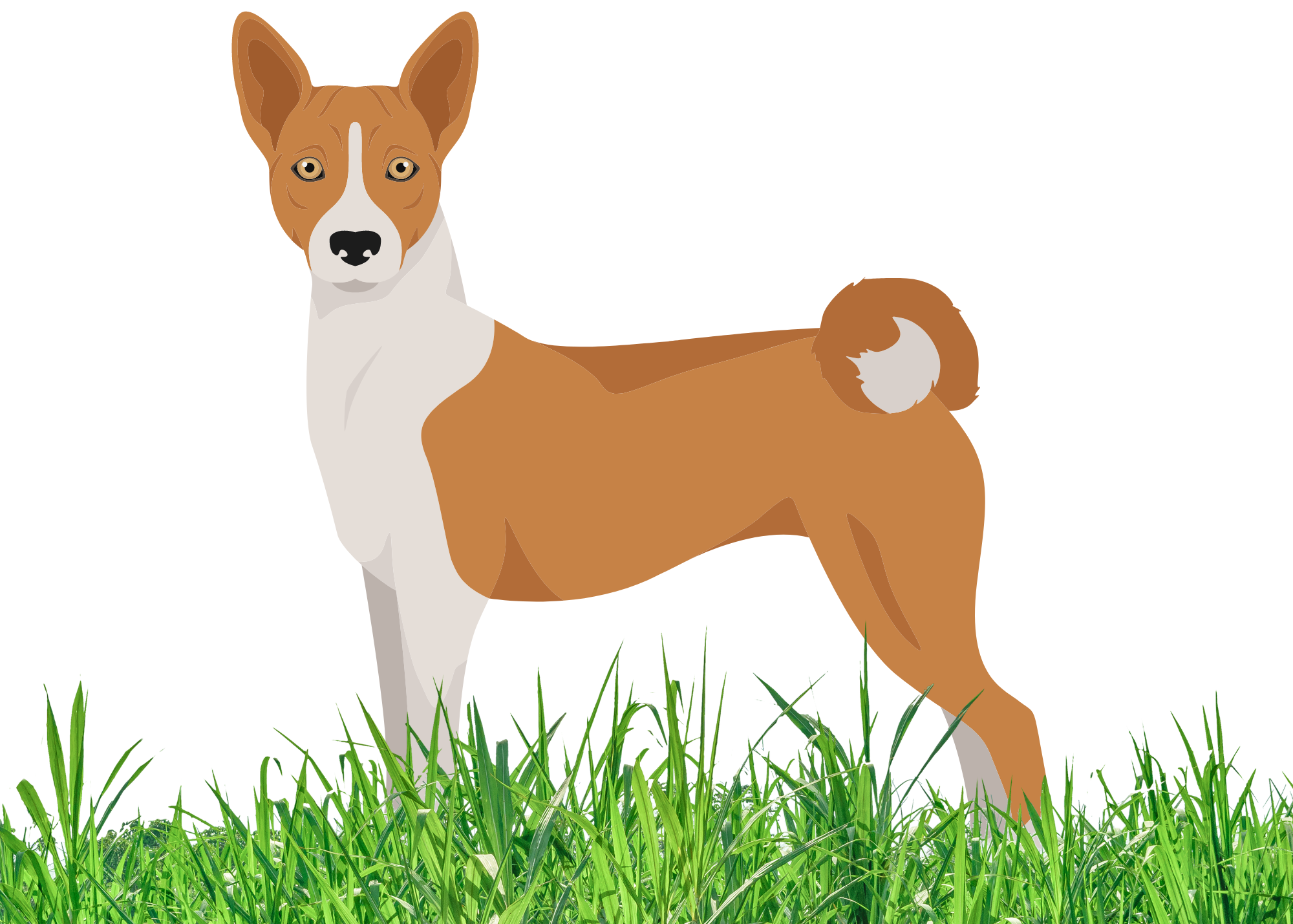
Your Match: Basenji: Smart, Poised, Independent
The Basenji, Africa’s ‘Barkless Dog,’ is a compact, sweet-faced hunter of intelligence and poise. They are unique and beguiling pets, best for owners who can meet their exercise needs and the challenge of training this catlike canine.”
Really? I am a person who dedicated my life to training, trialing and breeding herding-working Border Collies, and my ‘match’ is a Basenji? Dang. If you were to ask, “what is the opposite side of the breed spectrum to a Border Collie?” I’d probably pick the Basinji!
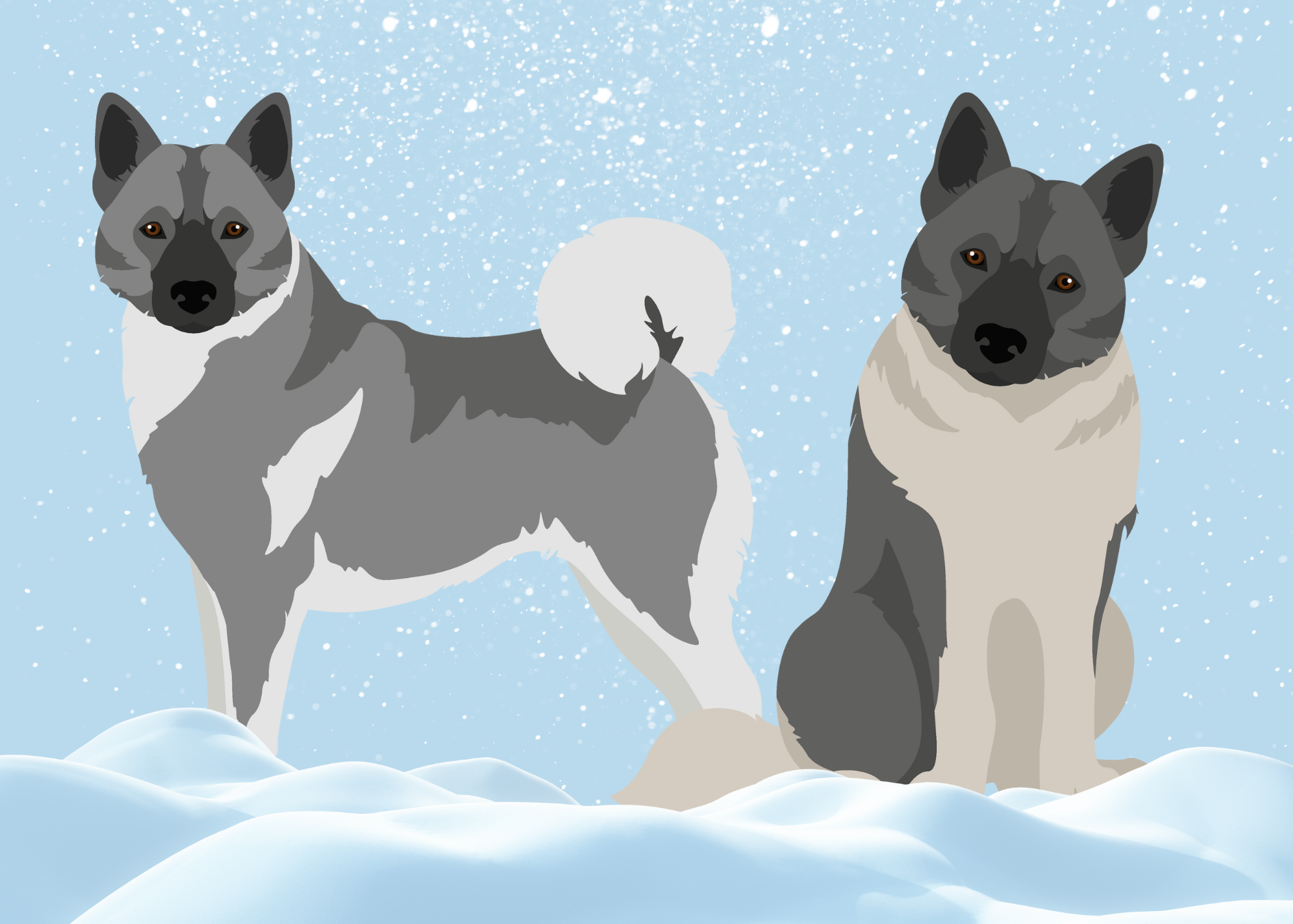
The Iams dog food site suggested that the Norwegian Elkhound must be my new best friend.
Pedigree produced a list of eight options including the Bulldog, Clumber spaniel, Dandie Dinmont Terrier, Ibizan & Pharaoh hound, Keeshound, American Eskimo Dog and the Petit Basset Griffon Vendeen. Holy cow! What a variety! Two sight hounds, a very cute scent hound, a terrier, a spaniel, a Nordic dog and its cousin.

There isn’t one dog across three on-line Breed Selectors that I would consider a good match for my character, although I could co-habitate with any of them. They are all great dogs. But, they are wrong for me! And by that statement I mean who I am. I’m talking about what moves me and makes me happy – deep down, not at the surface.
Let’s face it, I am going to be me regardless of where I live and whether I’m doing well financially or living on a shoe string budget. I am going to be me whether I am single or married, living in an apartment or on rural expanse. I am going to be me whether I am able to take long walks on the beach, or can’t walk because I need new knees. I have owned dogs while living in a third floor apartment in Chicago, a small house in town, a seven acre farmette and on fifty rural acres. It was always me.
If the breed selector surveys do not accurately capture my essence, they are likely going to miss the mark. Fortunately, people typically have a good sense of their own dispositions. What really matters is that a Breed Selector offers sound information that captures the dog’s true character. Why? It’s because a dog can live anywhere; eating rice and beans with its impoverished human or sharing rib-eye steak with its well-to-do owner. A dog can live in a castle or a hut, on a yacht or a cave, as long as it has the right relationship with its person it’s going to be content. That connection begins with the proper match of core impulses and it is completed with proper socialization and training. If you are the sort of person who can’t impose your will on a house plant, you need to partner with a dog that wasn’t designed to take control of situations. Then, of those more tractable breeds you may select a large or small, hairy or smooth coated, fast or lumbering dog.
Below you will find my “breed selector” process. Hopefully, you will find it valuable the next time you are considering bringing a new dog into your home.
How To Select A Dog Breed
There are people who have personality types that just grate on our nerves. And, there are folks with whom we feel comfortable sharing our lives and ourselves, intimately. Dog breeds were designed for a myriad of different occupations. Some jobs require strong, tenacious, stubborn determination and others demand the dog to have a softer side and desire to partner with or simply please a human. Selecting the wrong breed type for one’s lifestyle can result in a decade or more of torment – much like a bad marriage. While choosing the right breed type can result in what some people consider a match made in heaven. Based on my experience, one cannot rely upon the standard “breed selector” sites for assistance if they focus on your environment over your innate personality.
Regardless of breed, I believe that any dog can behave in a properly social manner if his owner establishes and maintains those standards. Dogs are like humans. An individual can be gregarious or introverted, outdoorsy or a high-rise inhabitant. Both species can learn how to be polite when interacting in a social setting. And yet, what makes a great partnership with a dog isn’t just about whether he doesn’t jump up or will sit when told. The best relationships are forged at a deeper level and arise when it just feels good to simply hang out or do a job together. If the relationship meets the dog’s needs for benevolent leadership (which may appear different from one breed to another), then a terrier doesn’t need to hunt vermin nor does a Border Collie need to herd sheep to feel fulfilled. On the other hand, if the relationship is misaligned, the dog’s sense of security or comfort cannot be rectified merely by giving him a hobby.
Domestic dog is a species beyond compare. None other has been as integrated nor manipulated by humans than Canis lupus familiaris. Modern dogs retain a strong genetic tie to the Gray Wolf. In fact, dog is a subspecies of the wolf. Still, humans have had a very significant influence on how our canine companions not only appear physically, but react behaviorally.
Before domestication, many experts speculate that the wolf (or at least some individuals within the species) existed on the outskirts of human civilization scavenging on discarded trash. Tamer individuals pressed closer to human establishments while the more skittish wolves probably retreated until a heritable divide was forged. Once the bond between the humans and dogs intensified, the potent genetic diversity of the wolf played a significant role in the development of unique groups of working partners. In time, these selection pressures resulted in significant extremes in body style and shape, coat length and type, ear set, color, and of course, the size in our domestic dogs. However, the most important selection criteria had little to do with dog’s appearance. History tells us that dogs were initially developed as beasts of burden – employed to perform jobs as hunting companions, vermin controllers or livestock guardians. Their form followed their function. For that reason, it’s not difficult to assume that a dog’s natural ambition (perspective, point of view or motivation) defines the animal more than does its appearance. Selecting a dog based on appearance, then, is probably similar to selecting a human life partner based on looks. There’s a pretty good chance of getting a mismatch.
Before selecting a dog, one should commit sufficient time understanding the type of work for which a breed was originally designed. The answer to that question will provide insight in the dog’s character; what makes him tick, what he seeks to be happy and comfortable in his own skin. It will define his eccentricities and temperament, his mental capacities and his mindset. It will explain his body style, and how he will use it. Most importantly, it will provide insight on how much or little he needs to partner with his humans to feel fulfilled. Understanding a dog’s roots within human society will illuminate the type of leader he will expect of his owner. That is critical because it will shed light on whether the dog’s person will feel comfortable living with the dog while maintaining her normal lifestyle.
Choosing A Breed
To evaluate which breed is right for you, examine your own lifestyle, first. How much do you want to work at keeping your new dog happy and healthy; mentally and physically? Notice that I did not write “how much time do you want to spend grooming him.” If the dog’s character fits, the perceived burden to provide routine maintenance may shift. They may not. I’m suggesting that first evaluate a dog’s innate character and disposition which is rooted in the original purpose of the breed. Then, move to other qualities like coat length, ear position or size.
Some breeds have very high standards of their humans and will require a significant amount of time simply to keep them mentally nourished. Others are content merely knowing the location of the food and water bowls and appreciating that they have a soft place to sleep. These dogs demand little in the way of a sophisticated partnership with their human.
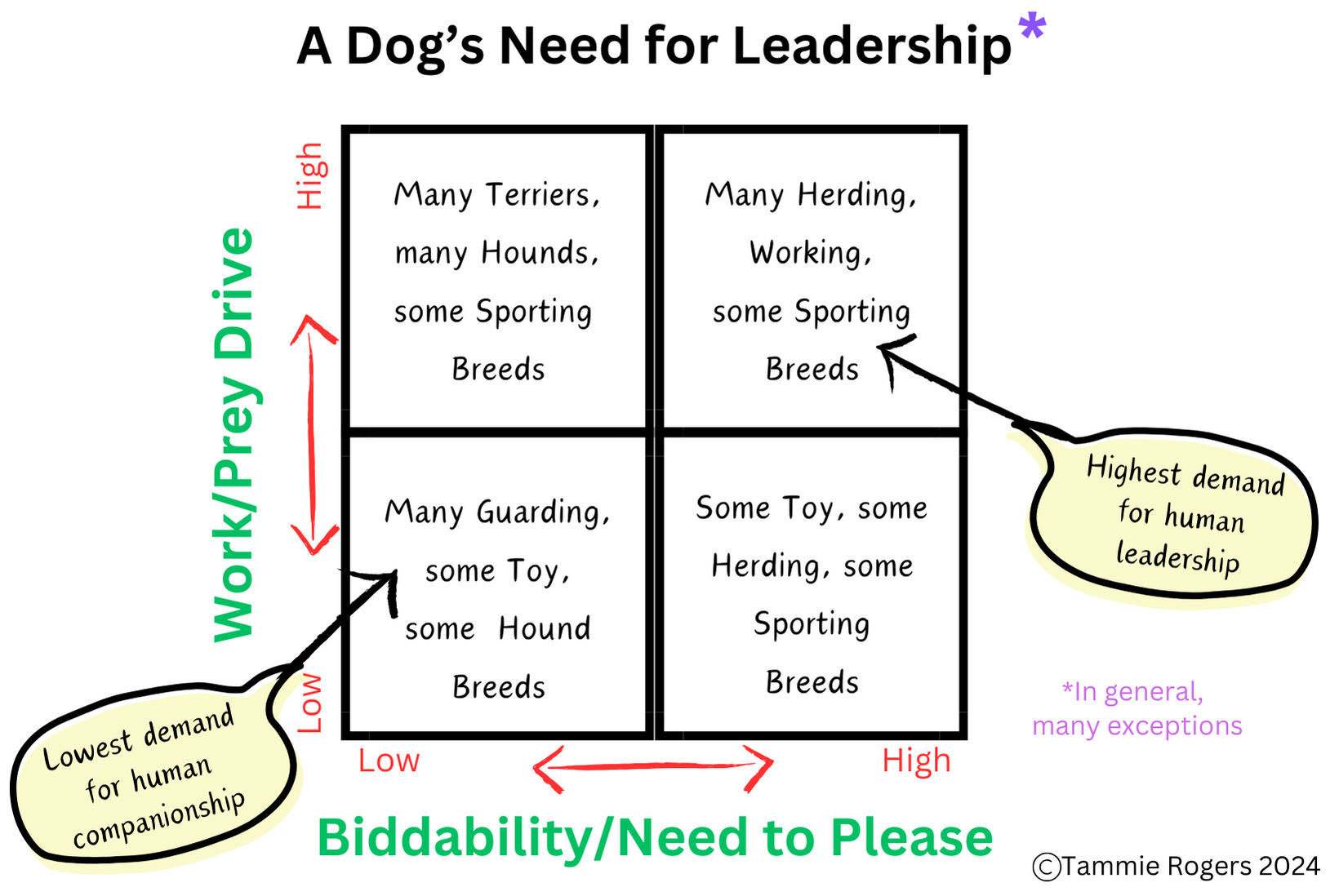
One way to examine a breed against your lifestyle is to look at two very important selection criteria. In order to perform the job for which it was originally developed, the breed has ended up with a unique combination of biddability versus work drive. The arrangement of those two qualities can provide a good measurement of the breed’s disposition and sheds light upon the resources that it may require from the owner as its leader and partner.
Biddability
Biddability is a willingness to do what is asked. It is a demonstration of obedience, tractability, docility and submission. Dogs with a high level of biddability ache to partner with their humans. They are not fulfilled without being given the chance to please their owners.
The work of a highly biddable breed tends to be that which demands cooperation with a human, rather than mere autonomous effort.
Highly biddable dogs can be a challenge to keep because they expect something of their owners that exceeds basic maintenance like food, water, exercise and grooming. A biddable dog anticipates being engaged with its owners for some part of each day, or it may become quite unhappy.
Prey / Work Drive
Prey drive or work drive is a desire to pursue quarry or to seek the challenge of a job.
During the domestication of dog, some breeds were designed with a high motivation to do work. Dogs with a strong prey drive tend to be willing to trail or chase moving objects like toys or small animals. Breeds that are well known for hunting have high prey drive. Herding dogs (that do not actually ‘hunt and kill’, but rather ‘contain and control’ their charges) also fall into this category. The working breeds like the Doberman Pincher, Newfoundland or Rottweiler may also be categorized as having high work drive. Dogs with high prey or work drive are often very good at games like retrieving or tug-of-war which can be motivators or rewards for other activities like schutzhund, tracking, obedience training or agility. On the contrary, some working breeds have been designed with little or no prey drive in order to be successful at the jobs for which they were designed. These include the livestock or property guardian breeds.
In general (with many exceptions), breeds fall into one of four quadrants which define the amount of work drive versus the amount of biddability the breed presents. Understanding where your desired breed falls will provide insight on how much leadership your dog will need from you. When choosing a new dog – if your personality type isn’t suited for the level of leadership your “perfect” breed needs or if you have higher expectations for partnership than your desired breed may be able to offer – you may want to rethink your decision. Hopefully, you will have your dog for 12 or more years. Making a good decision before you acquire your new puppy can have an impact on the next decade or more of your life!
Low Prey Drive / Low Biddability
Breeds that fall into the ‘low prey drive + low desire to please’ quadrant tend to be fairly easy keepers. They do not want to kill your cat or chase children on bicycles and they are not all that concerned about how much effort you can contribute to being their leader. There are massive breeds and diminutive breeds that fall into this category. The livestock guardian breeds, like the Great Pyrenees, have little desire to chase after small animals. Instead, they take ownership of them and guard them from outside threats. A Great Pyrenees that presents with too much prey drive could end up chasing and even killing the baby lambs that it was designed to defend, so that quality was selected out of the breed by the people who developed it. That trait is one of the differences between guarding work and prey-driven tasks (such as hunting or herding.) The livestock guardian dogs (LGD) have a good work ethic, but it will not be displayed as a willingness to partner and do activities with humans. Guarding breeds, which include most of the Mastiffs, may become overly territorial and typically prefer to work autonomously. Breeds defined as excellent “watch dogs” may fall into this category. For example, the Lhasa Apso, which was developed over 1000 years ago, was designed to guard important buildings. Some toy breeds fall in the low prey drive / low need to please category. The Pekingese, for example, is a fairly independent breed that has little need to please its owner, but also does not have a high prey drive so it won’t likely chase the family cat. The word “independent” in a breed definition is often an indicator for “low biddability.”
High Prey Drive / Low Biddability
Scent hounds, sight hounds and terriers tend to fall into the category defined by high prey drive paired with low biddability. These breeds can perform the jobs for which they were originally designed without much intervention or guidance from their human leader. When a Beagle gets onto the trail of a rabbit, he does not stop and turn back to his human to question, “Hey, I have found a rabbit trail, shall I follow it for you, Master?” No, the Beagle simply follows the trail. He can feel happy and fulfilled simply by performing the job for which he was bred with little or no assistance from his human. Low biddability does not imply that the dogs do not enjoy human companionship. However, these breeds have low demand a strong human leader. Dogs in this category are often considered stubborn, but in fact, they simply do not need to please their humans to feel good about themselves. It takes a a person with a certain personality to love these breeds. The hounds tend to make exceptional companions for people who enjoy the company of dog but who do not have a lot of time for sophisticated training. These breeds do need proper management (hounds should have the freedom to run and explore in a well fenced area), but they probably won’t feel overly deprived if their owner fails to offer daily mental exercises. The hound breeds that were developed to hunt in packs are typically very amiable with other dogs, and may fulfill their need for companionship from other dogs as much as from humans. Terriers have the tenacity and willful spirit that is highly entertaining until their owners expect them to comply!
All breeds benefit from clear boundaries and limits for their behavior. They all require appropriate exercise for their size and activity level. However, to take on the challenge of changing a terrier’s view on life may be quite taxing for some folks, while others will define it as nearly impossible.
Low Prey Drive / High Biddability
Breeds with high biddability but low prey or work drive typically make wonderful companions and entertaining pets. These dogs typically do not have a need to do highly sophisticated jobs, but they have very high affinity to their humans. They are usually easy to train. They need people. They do not need a high powered job to be happy, but they do enjoy partnering with their humans towards some type of goal. Many breeds were originally designed for a fairly challenging job that has now become obsolete. The Collie and the St. Poodle come to mind. Many individuals of these breeds no longer herd or hunt, but instead have been bred as cooperative, intelligent, companion animals. Their work drive can be redirected towards less “intense” work such as agility or obedience competitions, where they excel. Many Toy breeds, as well as some of the Terriers fall into this category. A breed with a low prey drive and high biddability may be just the right dog for someone who finds it undesirable trying to supply her pet with a serious job, but who enjoys a smart dog that wants to interact.
High Prey or Work Drive / High Biddability
The dogs that top the scale in both work drive and a compulsion to please are usually brainy breeds that still perform the job for which they were bred, or an off-shoot of that work. Many herding and working breeds are in this quadrant. While intelligence and a strong desire to please are often criteria that people believe they want in their pet dog, the combination can results in a dog that is needier of both mental and physical exercise than most people can dedicate to their pet dog.
High Work Drive + High Biddability breeds have lofty expectations for impeccable leadership. Their original work was often dangerous and required trust in a highly competent commander-in-chief.
As an example, a herding dog cannot perform the job for which it was bred without a human partner. Herding work can be life threatening, especially when working with a rank bull or ewes with lambs. If the shepherd errors and gives the dog the wrong command at a critical time, the dog could be killed. These breeds often have the capacity for intelligent disobedience, while maintaining a high level of compliance in all other situations. This requires a highly sophisticated canine mind; something that may be more than an average dog owner truly wants to handle. A dog with a strong work drive and high biddability will make an excellent companion for someone who wants to pursue an interactive sport such as Agility, Search & Rescue or who may use the dog for its original intended purpose like ranch work, military or police support. Before selecting one of these breeds as pet, it’s critical to understand that such a dog will feel lost without sound and fair leadership. The task of owning such a breed may be daunting to many.
A Personal Example
Once I acquired my first Border Collie, I knew it was the breed for me. For most of my career in corporate America, I held leadership roles. Later, I became my own boss and launched and managed three companies. I’m a bit of a control freak and I have often been hindered by perfectionism. I think fast. I take control and I am irritated by indecision. Border Collies get me, and I get them. They take their work very seriously, and I respect that. They learn swiftly and are able to make quick decisions. I admire those qualities. Their disposition often spurs curious quirks that I am able to overlook or help resolve. As a single woman in my 30’s I purchased a dilapidated, 100 year old farm that was located over seventy miles from my job because my dogs needed sheep to work and I ached to learn my dog’s craft through our partnership. I was not to be stopped. That is how motivated I was to partner with my Border Collie. Border Collies made sense to me, and I made sense to my Border Collies.
Finding the right breed for your lifestyle is about discovering a dog that gives you everything you need, knowing that the dog will be satisfied with what you have to offer, and knowing that neither feels overwhelmed or under satisfied.
In my book Shamaron – Dog Devoted, which is about my first Border Collie, I write:
At first I presumed you were challenging my authority. When I recognized that you were questioning my judgement, I understood what a precious gift you were.
That statement sums up how I feel about a good dog – one that reveres my position, forgives my imperfection and respectfully overrides my bad choices. There should be a serious emphasis on “…how I feel….”
Very often when working with clients, I find myself asking, “so, why did you get this breed of dog?” I’m usually prompted to ask because I can sense that many of the issues the person is having with her dog is related to the breed she chose.
“Well, I got him because my Uncle had one when I was a kid and I just loved that dog.”
It’s not the dog’s fault that his innate motivation in life is not being considered. He gets frustrated which leads to naughty behavior. She gets frustrated and yells at the dog in a language he doesn’t understand. She should have a different breed and her life would be amazing and her dog would be happy and content.
Snuggling up with an Italian Greyhound at the end of a busy work day can be far more satisfying than trying to placate a Malinois’s motivation to perform outrageous feats of Parkour during your evening walk.
In Conclusion
When researching your next best canine friend, I suggest that you examine the four quadrants of breed drive versus biddability. What sort of personality would match your disposition, perspective on life and your leadership style? It is a given that you need to teach your new dog to be well mannered. If your dog drags you all over the place on a leash, jumps up on your neighbors or barks incessantly, you are probably not going to enjoy his company and he’s going to be unhappy, too.
Naughty, unmannerly or anti-social behaviors do not define a dog’s innate character. You can, and should put in the effort to teach your pet to be socially compliant and well mannered, regardless of its breed or backstory.
In order to go beyond the basics of cohabitation and truly enjoy your dog’s character, select a breed that makes sense to you – the real you – the you that exists outside of fashion or funds or intermittent frustration of daily life.
Acquiring a new puppy is a very big decision and one that should not be made lightly, nor based on inadequate understanding. Your dog’s behavior will be a direct reflection of his psychological well-being which is directly related to how he feels about your leadership and management. A breed that is “good’ for one individual is a horror for another. Taking the time to truly understand what you want and how you can get it will be worth every moment.

